The Montessori Binomial Cube: Purpose and Presentation
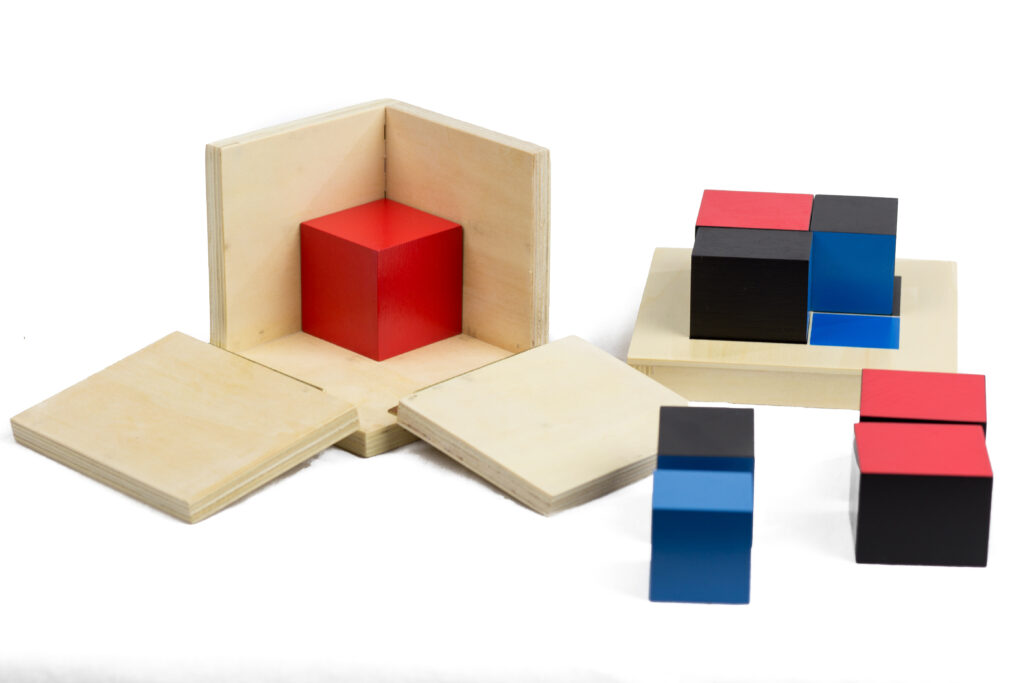
At first glance, the Montessori Binomial Cube can be intimidating to teachers, as well as caregivers who are looking to
Montessori supports the idea that children learn best when their senses are involved. Maria Montessori developed her Method and materials with the idea that cognitive development could be aided when a child used their senses when learning the ideas that were presented to them. Montessori sensorial materials are utilized to aid in refining the senses for this level of learning.
Maria Montessori’s ideas on the importance of providing a sensory-based groundwork for learning were built on the work of Jean Marc-Gaspard Itard (1775-1838) and Edouard Seguin (1812-1880). Seguin emphasized the importance of education through physical activity and Itard emphasized developing discrimination of the senses by isolation.
Montessori sensorial materials build on these ideas. Dr. Montessori developed her sensory materials and trialed them at her Casa de Bambini in San Lorenzo to find that they work well in a prepared environment.
The sensitive period for learning through the senses is the first plane of development, from birth to 6 years old. This is the period of childhood where children absorb information from their surroundings. Sensory experiences enhance their learning during this time.
Dr. Montessori didn’t limit her materials to the refinement of only the traditional 5 senses, but 9.
Parents and caregivers looking to implement Montessori homeschooling may be wondering, “What are Montessori sensorial materials?” as they prepare their home, learning areas, and/or playroom. Above is an explanation and below is a materials list.
Involving the senses in learning can be done easily at home, even if Montessori materials are not available to you. DIY Montessori material guides are available online.
Also, don’t shy away from sensory bins for helping your child learn through their senses. While they are not a Montessori item, they can provide a fun way to further incorporate the senses into learning and play.
At first glance, the Montessori Binomial Cube can be intimidating to teachers, as well as caregivers who are looking to

Montessori sensorial activities are some of the most engaging for young children, as the elements introduced are always new and

Sensorial activities in Montessori are some of the most interesting for children. Focusing on one sense at a time is

Montessori sensorial materials provide a lot of fun and fascination for young children. This is because their purpose is not
The sensorial aspect of Montessori learning is one of the main reasons parents choose this education method for their children.

This important sense, which is usually taken for granted, can be a powerful tool for blind people throughout their lives.

Young children enjoy activities that involve water. Fortunately, there are so many fun Montessori water activities to choose from. The

Now that Spring is here, you may be looking for some fun Montessori outdoor activities. If you’re participating in the

In this article, you will learn the relationship between Montessori and outdoor play and specifically how Maria Montessori herself felt

Whether you are gearing up to send your child to a Montessori primary program, you are planning on Montessori homeschooling,